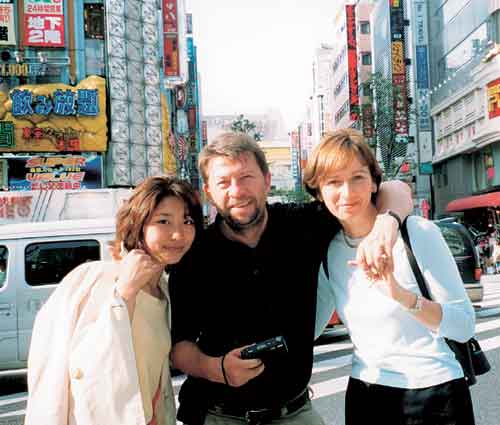
The Japanese seem to the rest of us to live several measurable clicks down the time line. The Japanese are the ultimate Early Adaptors, and the sort of fiction I write behoves me to pay serious heed to that. If you believe, as I do, that all cultural change  is essentially technologically driven, you pay attention to the Japanese. They've been doing it for more than a century now, and they really do have a head start on the rest of us, if only in terms of what we used to call 'future shock' (but which is now simply the one constant in all our lives).
Consider the Mobile Girl, that ubiquitous feature of contemporary Tokyo street life: a schoolgirl busily, constantly messaging on her mobile phone (which she never uses for voice communication if she can avoid it). The Mobile Girl can convert pad strokes to kanji faster than should be humanly possible, and rates her standing in her cellular community according to the amount of numbers in her phone's memory. What is it that the Mobile Girls are so busily conveying to one another? Probably not much at all: the equivalent of a schoolgirl's note, passed behind the teacher's back. Content is not the issue here, but rather the speed, the weird unconscious surety, with which the schoolgirls of Tokyo took up a secondary feature (text messaging) of a new version of the cellular telephone, and generated, almost overnight, a micro-culture.
A little over 100 years ago, the equivalent personal, portable techno-marvel in Tokyo would have been a mechanical watch. The printmakers of the Meiji period made a very large watch the satiric symbol of the Westernised dandy, and for the Japanese, clock-time was an entirely new continuum, a new reality.
The techno-cultural suppleness that gives us Mobile Girls today, is the result of a traumatic and ongoing temporal dislocation that began when the Japanese, emerging in the 1860s from a very long period of deep cultural isolation, sent a posse of bright young noblemen off to England. These young men returned bearing word of an alien technological culture they must have found as marvellous, as disconcerting, as we might find the products of reverse-engineered Roswell space junk. These Modern Boys, as the techno-cult they spawned came popularly to be known, somehow induced the nation of Japan to swallow whole the entirety of the Industrial Revolution. The resulting spasms were violent, painful, and probably inconceivably disorienting. The Japanese bought the entire train-set: clock-time, steam railroads, electric telegraphy, Western medical advances. Set it all up and yanked the lever to full on. Went mad. Hallucinated. Babbled wildly. Ran in circles. Were destroyed. Were reborn.
Were reborn, in fact, as the first industrialised nation in Asia. Which got them, not too many decades later, into empire-building expansionist mode, which eventually got them two of their larger cities vaporised, blown away by an enemy wielding a technology that might as well have come from a distant galaxy.
And then that enemy, their conquerors, the Americans, turned up in person, smilingly intent on an astonishingly ambitious programme of cultural re-engineering. The Americans, bent on restructuring the national psyche from the roots up, inadvertently plunged the Japanese several clicks further along the time line. And then left, their grand project hanging fire, and went off to fight Communism instead.
The result of this stupendous triple-whammy (catastrophic industrialisation, the war, the American occupation) is the Japan that delights, disturbs and fascinates us today: a mirror world, an alien planet we can actually do business with, a future.
But had this happened to any other Asian country, I doubt the result would have been the same. Japanese culture is 'coded', in some wonderfully peculiar way that finds its nearest equivalent, I think, in English culture. And that is why the Japanese are subject to various kinds of Anglophilia, and vice versa. It accounts for the totemic significance, to the Japanese, of Burberry plaid, and for the number of Paul Smith outlets in Japan, and for much else besides. Both nations display a sort of fractal coherence of sign and symbol, all the way down into the weave of history. And Tokyo is very nearly, in its own way, as 'echoic' (to borrow Peter Ackroyd's term) a city as London.(...)
But we don't reflect them back. We don't have any equivalent of the robot sushi bar in Harvey Nichols, which is as perfectly 'Japanese' a thing as I've seen anywhere, and which probably wouldn't look nearly as cool if it had been built in Tokyo or Osaka.
We don't have branches of Muji interspersed between our Starbucks (although I wish we did, because I'm running out of their excellent toothpaste). Muji is the perfect example of the sort of thing I'm thinking of, because it calls up a wonderful Japan that doesn't really exist. A Japan of the mind, where even toenail-clippers and plastic coat-hangers possess a Zen purity: functional, minimal, reasonably priced. I would very much like to visit the Japan that Muji evokes. I would vacation there and attain a new serenity, smooth and translucent, in perfect counterpoint to natural fabrics and unbleached cardboard. My toiletries would pretend to be nothing more than what they are, and neither would I. (If Mujiland exists anywhere, it's probably not in Japan. If anywhere, it may actually be here, in London.)
Because we don't reflect them back, in Vancouver, they don't market to us in the same way they market to you. (...)
The Japanese are great appreciators of what they call 'secret brands', and in this too they share something with the British. There is a similar fascination with detail, with cataloguing, with distinguishing one thing from another. Both cultures are singularly adroit at re-conceptualising foreign product, at absorbing it and making it their own.
Why Japan, then? Because they live in the future, but neither yours nor mine, and somehow make it seem either interesting or comical or really interestingly dreadful. Because they are capable of naming an après-sport drink Your Water. Because they build museum-grade reproductions of the MA-1 flight jacket that require prospective owners to be on waiting lists for several years before one even has a chance of possibly, one day, owning the jacket. Because they can say to you, with absolute seriousness, believing that it means something, 'I like your lifestyle!'
Because they are Japanese, and you are British, and I am American (or possibly Canadian, by this point).
And I like both your lifestyles.
Enjoy one another!"
Voilà ce que nous racontait William Gibson dans les colonnes de l'observer du 1er Avril 2001.
(c)Patrick Willemarck